In this article
- Why Barbershops Miss Important Customer Calls
- Ways to Answer Calls While Cutting Hair
- What Is an AI Receptionist for Barbershops?
- How a Call Turns Into a Booking
- How an AI Receptionist Helps You Never Miss Calls
- Key Features to Look for in a Barbershop AI Receptionist
- How to Set Up an AI Receptionist for Your Barbershop
- AI Receptionist vs. Traditional Receptionist for Barbershops
- How Much Does an AI Receptionist for Barbershops Cost?
- What to Expect, Honestly
- Is an AI Receptionist Worth It for a Small Barbershop?
- Try an AI Receptionist for Your Barbershop
- Conclusion
- FAQs
Yes, AI can answer the phone for a barbershop. An AI receptionist picks up every call, including mid-cut and after hours, answers questions about services, prices and hours, and books the appointment straight into your calendar, so the caller hangs up booked instead of calling the next shop.
A barbershop gets busy fast, and answering every call while you're cutting is not realistic. Someone rings to book, nobody picks up, and they move on. An AI receptionist for barbershops closes that specific gap, so a ringing phone stops being a choice between the client in your chair and the one trying to reach you.
This guide covers why those calls get missed, the options for answering them, what an AI receptionist actually does on a call, what to look for, what it costs, and where it falls short.
Why Barbershops Miss Important Customer Calls
You're halfway through a fade when the phone rings. Stopping isn't an option, so it goes unanswered — and by the time you're free, the caller has booked somewhere else. In a busy shop that happens several times a week, more at weekends.
The second problem is quieter and bigger. People look for a barber when they finish work or plan their weekend, which is usually after you've closed. Those calls never reach you at all, and most people don't try twice.
Neither of these shows up anywhere you'd notice. There's no report for "callers who gave up", which is exactly why the gap persists.
Ways to Answer Calls While Cutting Hair
There are five realistic options, and they fix different things:
| Option | What it fixes | What it doesn't |
|---|---|---|
| Updated info online | Hours, prices, location questions | Anyone who still wants to call |
| Call forwarding | Routes calls somewhere else | Someone still has to answer |
| Answering service | A person takes a message | Usually can't book into your calendar |
| Online booking | Self-service scheduling | Clients who prefer the phone |
| AI receptionist | Answers and books, any hour | Complaints and unusual requests |
Start with the cheapest one. Keeping services, prices, hours, and booking instructions current on your website and Google Business Profile removes a surprising share of calls before they happen.
Beyond that, it depends on what's actually ringing. If most calls are questions, better published information helps. If most are people trying to book, you need something that can take a booking. For the online side, barber booking software compares the options, and appointment scheduling software for salons covers salon teams.
What Is an AI Receptionist for Barbershops?
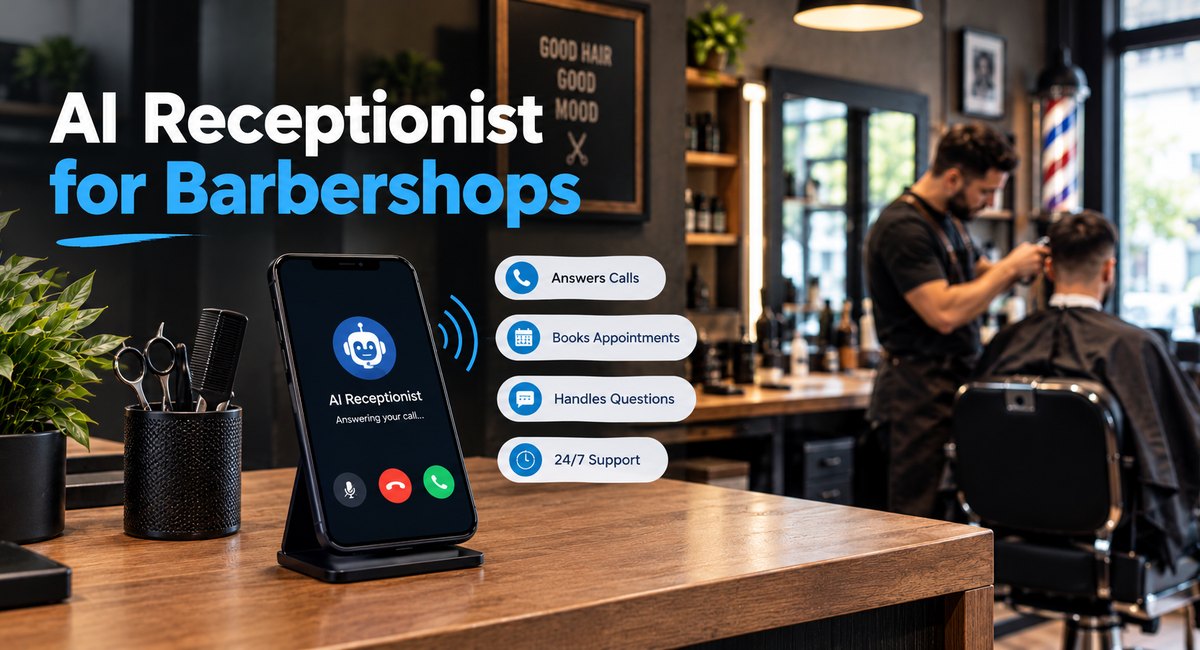
It's a voice assistant that answers your business line and handles what a front desk would: explaining services, quoting prices, giving opening hours, and arranging appointments.
Unlike an answering machine, it holds a conversation. The caller says what they want and gets a real answer rather than a beep and a promise that someone will ring back.
Connected to a booking calendar, it checks genuine availability and schedules against your team's real diary. Some services also handle rescheduling and cancellations by phone. What any particular product does depends on the provider and the integrations it supports, so that's worth confirming rather than assuming.
How a Call Turns Into a Booking
The call starts with the caller saying what they want: "can I book a haircut with Sam tomorrow afternoon?" The receptionist pulls three things out of that sentence: the service, the preferred barber, and the rough time.
It then checks availability against the real calendar, taking account of who is working, how long that service takes, and any gap you keep between appointments. If the slot is free, it offers it. If not, it offers the nearest alternatives.
Before saving anything, it should read the booking back (service, barber, date, time) and get a yes. That read-back is the step that catches misheard details, and it's worth checking that a provider actually does it.
Caller speaks → service and barber identified → availability checked → slot offered → details confirmed aloud → booking saved
Rescheduling and cancelling are separate capabilities, not automatic consequences of being able to book. If you want callers to change appointments by phone, confirm that specifically.
How an AI Receptionist Helps You Never Miss Calls
Answer calls around the clock
Customers don't only ring during opening hours. A service that answers 24/7 picks up the late-night and early-morning calls that currently reach voicemail, and gives those callers a way to book rather than a reason to move on.
Book appointments automatically
Booking by phone can take several minutes once someone starts asking about dates, services, and which barber is in. An AI receptionist checks available slots through the connected calendar and walks the caller to a time that genuinely exists, which also prevents the classic mistake of offering a slot with a barber who isn't working that day. Your customers don't need an app for any of it; our guide to a phone booking system for barbershops explains why many prefer it that way.
Handle multiple customer inquiries
At peak hours several people ring inside a few minutes, and one barber with a full chair cannot answer them all. An AI receptionist isn't limited to one call at a time in the way a person is, so the fourth caller gets the same answer as the first.
Reduce missed booking opportunities
A missed call isn't automatically a lost customer, but it hands that customer a reason to try someone else. Answering promptly — and being able to offer a real appointment rather than "call back tomorrow" — is what turns the enquiry into a booking.
Give barbers more time to work
Your clients came for a good haircut, not to watch you break off every few minutes for the phone. Handing over the routine calls keeps your attention where the paying work is, and cuts down the pile of callbacks waiting at closing time.
It doesn't remove the need for personal service. It reserves your attention for the moments where a person genuinely makes the difference.
Key Features to Look for in a Barbershop AI Receptionist
Not every service does the same things. The useful ones fit the way your shop already works rather than forcing you to rebuild around them.
| Feature | Why it matters |
|---|---|
| Calendar integration | Real availability instead of a stale list of times |
| Appointment scheduling | The caller leaves with a booking, not a callback |
| Service and pricing answers | Covers the questions that interrupt you most |
| Booking confirmations | The caller knows it worked |
| Reschedule and cancel | A cancelled slot frees up instead of sitting empty |
| Call forwarding | Keep the shop number your clients already know |
| Human transfer or callback | A route to a person for anything unusual |
| Call summaries | How you find out what it got wrong |
Ask specifically how the service behaves when it can't complete a request. That answer tells you more about a product than its feature list does.
How to Set Up an AI Receptionist for Your Barbershop
- Work out which calls you actually get. Prices, hours, which barber is in, appointment times — the mix tells you what to configure first.
- Prepare the details: services, how long each takes, working hours, booking rules, and your cancellation policy.
- Connect your phone and calendar, and decide whether callers ring a new number or you forward the one they already know.
- Test it before you rely on it. Call it yourself, after hours, on a mobile. Book a cut and beard trim together. Ask for a barber who's off. Cancel something and check the slot reopens.
- Watch the first week and fix whatever produced a wrong answer.
Most bad outcomes trace back to a missing detail in the setup rather than the assistant mishearing. Accurate information is the whole job.
Common setup mistakes
Out-of-date information. The conversation can sound perfect and still quote last year's price or book into a barber's break. Review the details every time your services, hours, or staff schedules change. This is the single most common failure.
Wrong appointment lengths. Set a skin fade at twenty minutes when it takes forty, and you get a calendar that looks healthy and a team running late all day.
Launching without testing the failure path. The important question isn't what happens when a booking works. It's what a caller hears when their slot is gone or their question needs you. Set up handover or callback instructions and test both before going live.
AI Receptionist vs. Traditional Receptionist for Barbershops
A person brings judgement. They calm an annoyed customer, read an unusual request, and handle the situations nobody wrote a rule for.
The trade-off is cost and coverage. A front-desk hire is a salary plus overheads, works set hours, and still can't answer the phone while serving someone at the counter.
An AI receptionist covers routine calls consistently and doesn't keep a schedule, but it can struggle with unexpected questions and anything outside its configuration. The two do genuinely different jobs — it works best alongside your own customer service rather than instead of it.
How Much Does an AI Receptionist for Barbershops Cost?
Pricing varies by provider. Some charge a flat monthly subscription, others bill by call minutes or usage, and there may be extras for setup, phone numbers, or integrations.
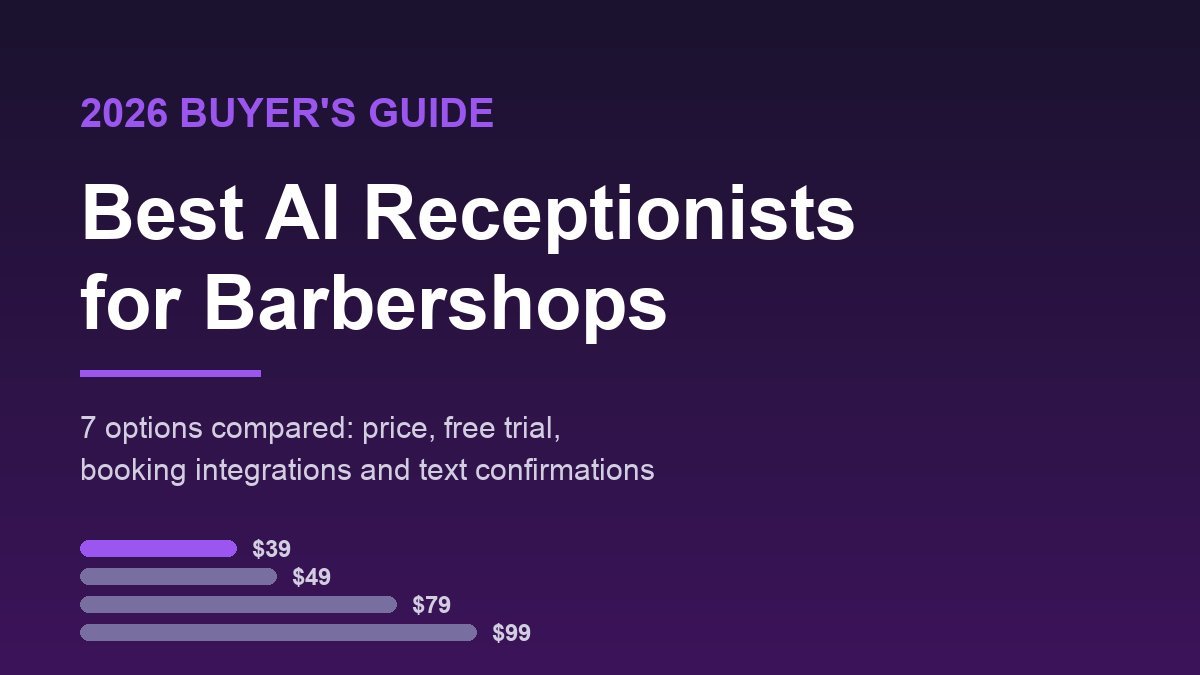
Compare what's actually included against your real call volume. A cheap plan isn't good value if it caps call handling or leaves out the booking features that were the point. To see how the main options stack up on price, trials and integrations, read our comparison of the best AI receptionists for barbershops.
Our own plans start at $39/month, and every account includes 15 free minutes with no card required, enough to test it on real calls before deciding. For a full breakdown, including what happens when minutes run out, see AI receptionist pricing for barbers.
To judge whether any of it is worth it, estimate from your own numbers: how many calls you miss in a typical week, how many of those would likely have booked, and what an average appointment is worth. That won't guarantee anything, but it turns the decision into arithmetic instead of a guess.
What to Expect, Honestly
Marketing in this category is full of specific numbers from unnamed shops: a thirty percent drop in no-shows here, a doubling of bookings there. Treat all of them, including any you see from us, as unverifiable. Results depend on your clientele, your location, and how far ahead people book, so another shop's percentage tells you almost nothing about yours.
What is reasonable to expect is mechanical. Calls that used to go to voicemail get answered. Enquiries that arrive at 9pm get captured. Slots that get cancelled properly become available again.
To know what it's worth to you, measure it. Count confirmed appointments for the month before you switch, then the month after. That single comparison beats every case study you'll read, including this one.
Limitations worth knowing about
Setup takes real time, particularly if you're connecting it to tools you already run. Budget for that rather than being surprised by it.
Some clients won't want to deal with an automated system. Older regulars in particular often prefer a person, and a setup that makes that harder costs goodwill. The aim is to catch the calls you were losing, not to redirect the ones you were already handling well.
Is an AI Receptionist Worth It for a Small Barbershop?
For a solo barber it's often the clearest case. You can't justify a full-time receptionist, but you still miss calls every single day you're busy.
It's worth considering if you regularly miss calls mid-cut, answer the same questions repeatedly, or get booking requests after hours. It's probably not worth it if your phone rarely rings or most clients already book online — automation captures demand that exists, it doesn't create it. If that's your situation, stop losing money on barbershop bookings covers the other levers.
Start by looking at your actual call history rather than the excitement around AI. For other jobs worth handing to software, see AI for barbers.
Try an AI Receptionist for Your Barbershop
If the phone keeps interrupting your work, BarberReceptionist is built for exactly this. It answers barbershop calls around the clock, understands services like fades and beard trims, books into Google Calendar, and handles reschedules and cancellations by phone.
You can hear recorded sample calls before speaking to anyone — three real shops, three different conversations. Then test it yourself on the calls that are actually awkward: two services at once, a specific barber, a time that's already taken.
For after-hours booking in more detail, see the AI booking assistant for barbers. If you run Square, Square integration for barbershops covers how services and prices sync, and virtual receptionist for barbers compares the human and AI versions.
Conclusion
Missed calls frustrate barbers and customers alike. When you're serving someone, answering every enquiry isn't realistic — and the cost of that shows up as bookings that quietly went elsewhere.
An AI receptionist bridges the gap by handling routine calls, answering the common questions, and booking appointments against a real calendar. Choose one that fits your existing booking process, make sure there's a clear route to a person for anything complicated, and judge it on confirmed appointments rather than on how it sounds.
FAQs
What does an AI receptionist do for a barbershop?
It answers incoming calls, responds to common questions about services, prices and hours, and books appointments. Many also handle rescheduling and cancellations.
Can an AI receptionist book haircuts automatically?
Yes, where it is connected to a booking calendar. It checks genuine availability and confirms the appointment, rather than offering times that are already taken.
Can an AI receptionist answer calls after closing time?
Yes. Services with 24/7 coverage answer outside opening hours, which is when a lot of booking intent actually arrives.
Does an AI receptionist work with Square Appointments?
Compatibility varies by provider, so check before subscribing. BarberReceptionist syncs your Square catalogue so services and prices come from the list you already maintain, and books appointments into Google Calendar.
Is an AI receptionist suitable for a one-chair barbershop?
Yes, and solo barbers often get the clearest benefit, since there is nobody else to answer the phone. The question is whether the cost matches the bookings you are currently missing.
Can I keep my existing barbershop phone number?
Usually, by forwarding calls from the number your clients already know to the receptionist. Ask the provider which options it supports and whether they cost extra.
What happens when a caller needs to speak to a person?
Depending on the setup, the receptionist may transfer the call, take a message, or arrange a callback. Confirm the fallback before launch and test it yourself.
Will callers know they are speaking to AI?
Modern voice AI sounds natural, but some callers will still prefer a person. Make sure anyone who asks has a route to your team.